What You Will Learn
“Don’t ask what the world needs. Ask what makes you come alive, and go do it. Because what the world needs is people who have come alive.” ~ Howard Thurman, author, philosopher, theologian, educator and civil rights leader
A college degree in Fine Arts offers excellent preparation for any career rooted in aesthetics, good design, creative thinking, planning and production.
Curriculum
The visual arts curriculum at CCM features a 37-credit core encompassing courses in drawing, 2D and 3D design, color theory, painting, sculpture, ceramics and more. You will also create a design portfolio for your future educational and career needs. This solid foundation enables you to consider advanced study in the areas of studio art (drawing, painting, sculpture, and ceramics), art education, art history, art therapy, design, graphic design and photography.
Careers in the Field
Here is a sampling of opportunities awaiting you upon completion of your Associate in Fine Arts (AFA) degree!
- Artist
- Art Dealer
- Art Teacher
- Art Therapist
- Conceptual Artist
- Framer
- Gallery Owner
- Illustrator
- Museum Curator
- Painter
- Printmaker
- Professor
- Sculptor
- Special Effects Artist
Where You Can Go
The AFA degree in Visual Arts at CCM is designed to provide a strong foundation and is for students planning to transfer to accredited four-year colleges, universities, art institutes, or specialized schools of art and design that offer visual design programs. CCM students have been successfully in transferring to the following schools:
- California College of the Arts
- Drew University
- Fairleigh Dickinson University
- Fashion Institute of Technology
- Jersey City State University
- Kean University
- Maine College of Art
- Maryland Institute College of Art
- Massachusetts College of Art and Design
- Montclair State University
- New Jersey Institute of Technology
- Parsons The New School for Design
- Pratt Institute
- Ramapo College
- Rider University
- Ringling College of Art and Design
- Rhode Island School of Design
- Rutgers University
- Savannah College of Art and Design
- School of the Art Institute of Chicago
- School of the Museum of Fine Arts
- The Art Institute of Boston
- The College of New Jersey
- West Virginia University
- William Paterson University

Why Study Visual Arts at CCM?
The faculty are a team of professionals and nationally and internationally exhibited artists. Their artworks are represented in museums, state and local government buildings and large corporations.
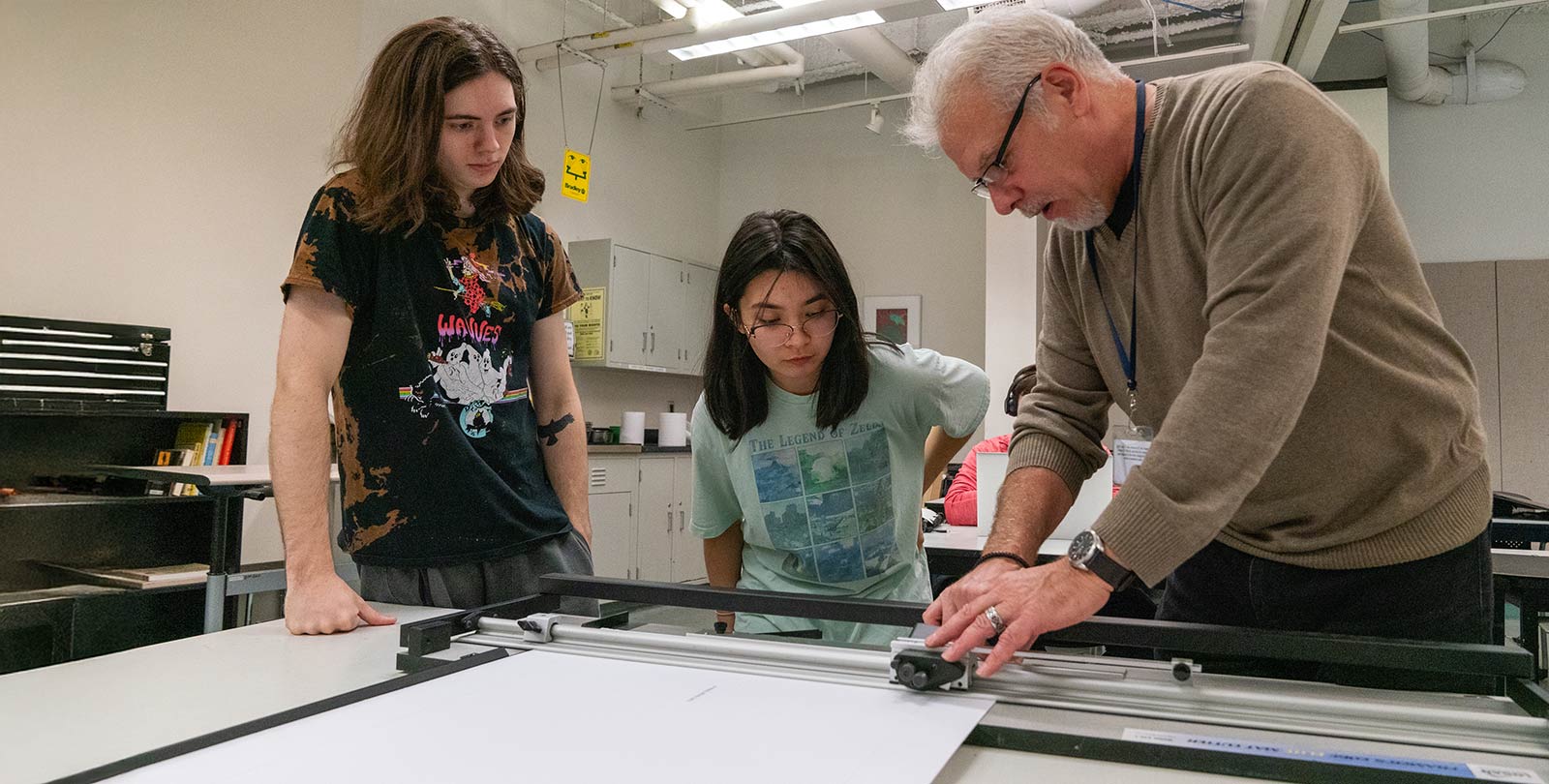
The facilities in Visual Arts are large, open spaces with natural lighting, state-of-the-art equipment and comfortable modern furnishings that facilitate and enhance students’ creative endeavors.
The Visual Arts Program offers students a solid foundation in the areas of Studio Art (Drawing, Painting, Sculpture and Ceramics), Art Education, Art History, Art Therapy, Design, Graphic Design and Photography. Students develop an understanding of the visual arts through the intensive study of technique, history, theory, concept and hands-on approaches in studio work, and may take studio electives in a variety of media. The Visual Arts curriculum is transferable into B.F.A. and B.A. degree programs in Fine Arts, Art Education, Art Therapy, Art History, Photography, Design and Graphic Design at four-year colleges, universities, schools of design and institutes of art.
Paying For Your Visual Arts Education
Earning an associate degree in visual arts is a powerful investment that will pay off over the course of your life, in both increased earnings and job satisfaction. But what is the upfront cost, and how do you afford it?
There’s good news: Money is available to help you pay for school! Our Financial Aid staff can provide lots of information about the process of finding funds to help pay for your education.
Featured Courses
Drawing I & II
Learn the methods, materials and visual information needed to draw what you see. In the studio, faculty lead you through a series of simple exercises designed to build competence and confidence to complete a sketch book and a portfolio of still life, landscape, perspective and portrait drawings using pencil, charcoal, crayon and ink. Drawing II includes a study of basic anatomy for artists and an intro to drawing from live nude models, both male and female.
Three-Dimensional Design
Through lectures, multimedia presentations and assigned projects, you can use a variety of materials along with planning, sketching and modeling, to learn to understand and control the visual and physical forces inherent in the creation of three-dimensional objects. Complete the class with additional portfolio work and the skillset to pursue further studies in sculpture, ceramics, design (product, industrial, interior, fashion) and architecture.
Animation
Use 3D modeling and animation software to create animated imagery for video and multimedia applications. Software includes 3D Studio Max (3D animation) and Adobe Premiere and AfterEffects (digital video). Through assigned projects, students learn to combine live video and animation with compositing and bluescreening techniques.
Resources